

Ruby
Ruby is the most valuable variety of the corundum mineral species, which also includes sapphire.
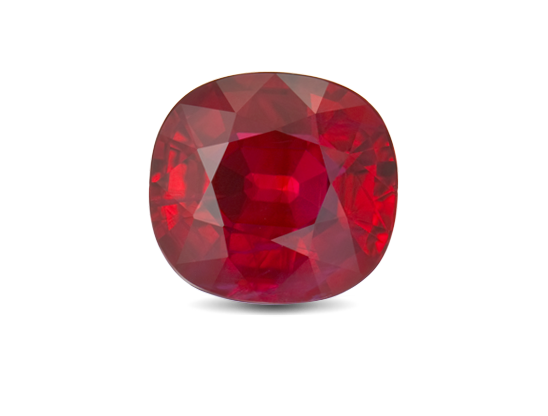
OVERVIEW
ABOUT RUBY
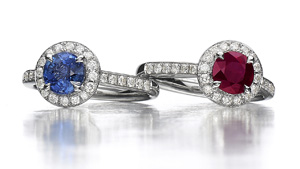
Rubies can command the highest per-carat price of any colored stone. This makes ruby one of the most important gems in the colored stone market. In its purest form, the mineral corundum is colorless. Trace elements that become part of the mineral’s crystal structure cause variations in its color. Chromium is the trace element that causes ruby’s red color.
Birthstones & Anniversaries
Ruby is the birthstone for July and the gem for the 15th and 40th anniversaries.
RATNARAJ
In Sanskrit, ruby is ratnaraj, meaning the king of gems.
MOGOK
Myanmar’s legendary valley of rubies; the source of many of the world’s most fabulous gems.
$32.4 million
On May 12, 2015, a 25.59-carat ruby ring sold for $1,266,901 per carat, setting a new record at auction for a colored gemstone.
FACTS
Mineral: Corundum
Chemical composition: Al₂O₃
Color: Red
Refractive index: 1.762 to 1.770
Birefringence: 0.008 to 0.010
Specific gravity: 4.00 (+/- 0.05)
Mohs Hardness: 9
TREATMENTS
There are a number of processes used to alter the color, apparent clarity, or improve the durability of gems.
SYNTHETICS
Some gemstones have synthetic counterparts that have essentially the same chemical, physical, and optical properties, but are grown by man in a laboratory.
IMITATIONS
Any gem can be imitated—sometimes by manmade materials or by natural materials chosen by man to impersonate a particular gem.
WHY WE LOVE THIS GEMSTONE

1
Intense Red Glow
Fine ruby glows with intense red in sunlight thanks to red fluorescence, which intensifies its red color.
2
First laser
The first laser was created in1960 using the red fluorescence light emitted by ruby.
3
Chromium
Chromium causes ruby's red. Gemologists consider it the "rock star" of trace elements.
QUALITY FACTORS
The prices of fine-quality rubies have been breaking auction records.
COLOR

Color is the most significant factor affecting a ruby’s value: Fine gems are a pure, vibrant red to slightly purplish red.
CLARITY

If a ruby's inclusions affect its transparency or brilliance they reduce the gem’s value significantly.
CUT

Rubies are commonly fashioned as mixed cuts, which have brilliant-cut crowns and step-cut pavilions.
CARAT WEIGHT

Fine-quality rubies over one carat are very rare and price goes up significantly as size increases.
RUBY QUALITY FACTORS: THE COMPREHENSIVE GUIDE
RESEARCH
Explore sources, gemological research, and the role of gems in history.

The 3309 cm⁻¹ Series in Sapphire and Ruby: A Focus on FTIR Peak Position Variation
Wasura Soonthorntantikul and Aaron C. Palke , Jun 5, 2025


RECOMMENDED READING

Rubies & Sapphires
Fred Ward

The Ruby, Sapphire and Emerald Buying Guide: How to Identify, Evaluate and Select These Gems
Renée Newman
Ruby & Sapphire
Richard Hughes


