
Diopside and Danburite in Rare Orange Sodalite
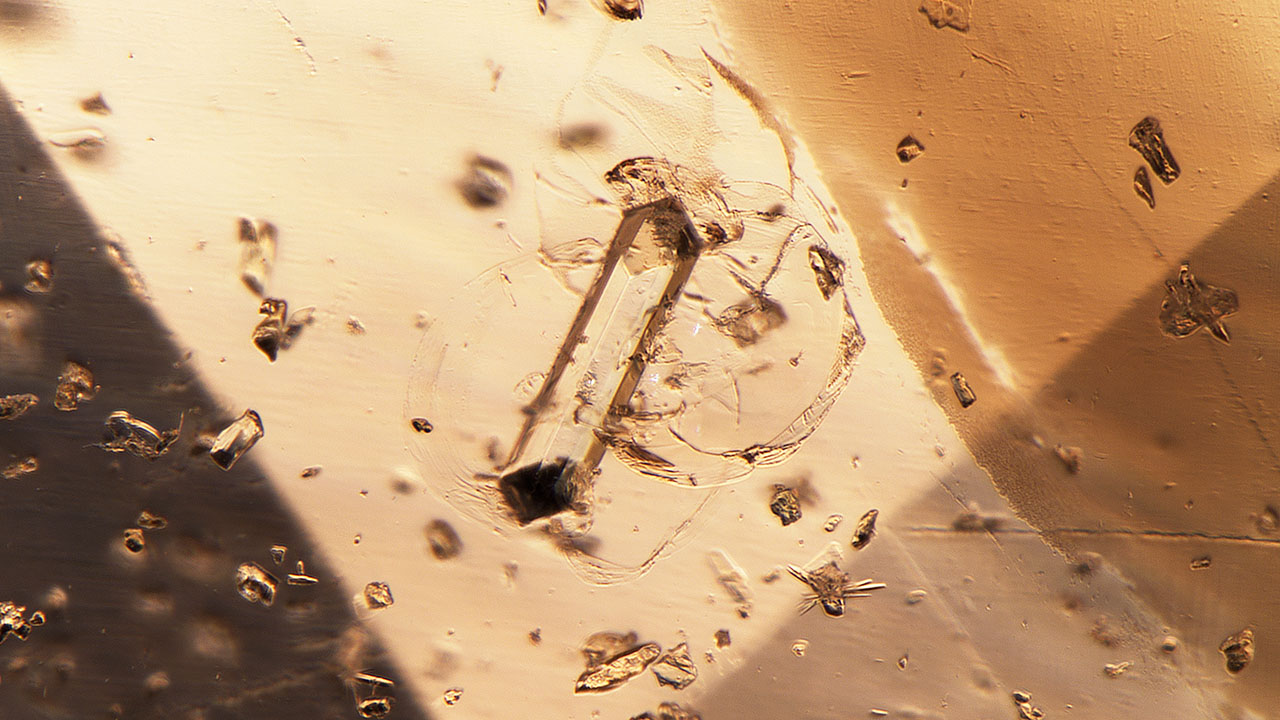
A rare orange sodalite was recently examined by the authors. The 2.83 ct stone, identified by Raman spectroscopy along with standard gemological testing, revealed a variety of unique inclusions upon microscopic examination.
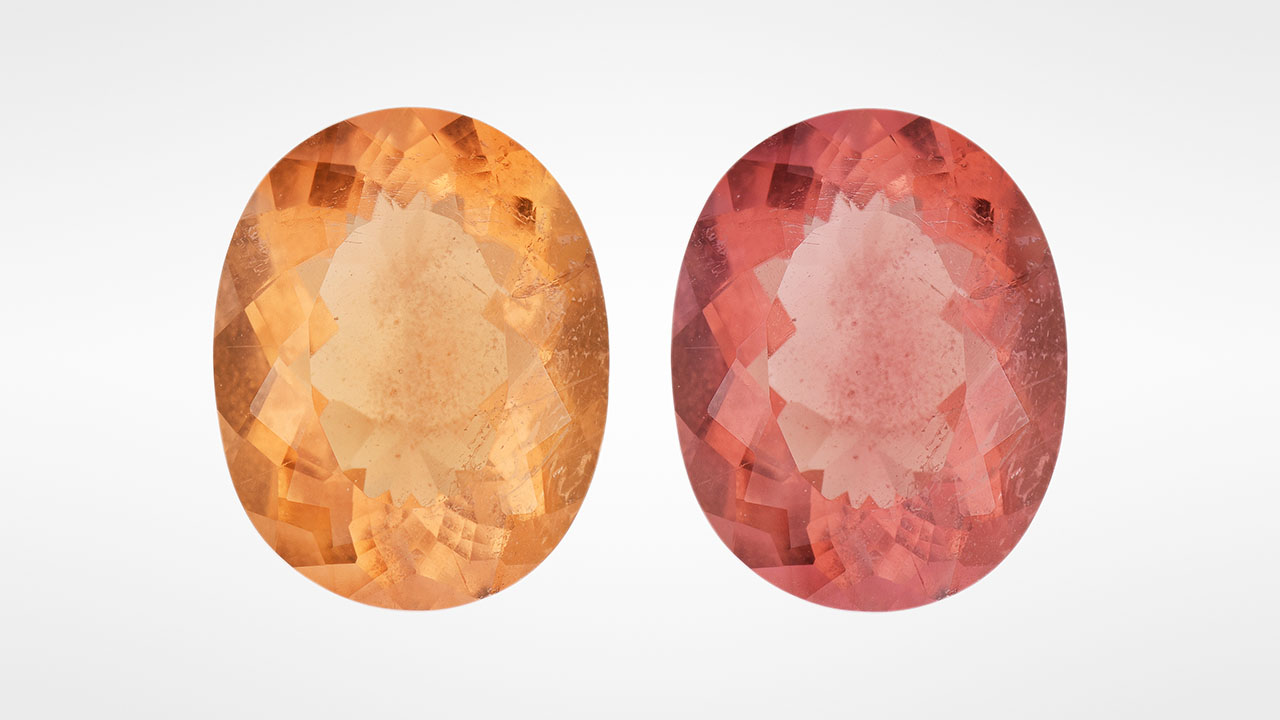
A field of transparent crystals identified by Raman was found to consist of mostly diopside with a few intermixed danburites, which can be seen surrounding a larger euhedral, prismatic diopside in figure 1. Transparent facet-grade orange sodalite is uncommon, both for its color and high diaphaneity, as the complex tectosilicate sodalite is typically blue or colorless. The stone exhibited a short-lived reversible photochromism known as tenebrescence, changing from orange to pink after brief exposure to long-wave ultraviolet light and reverting to its stable orange color in a matter of minutes after removal of the long-wave UV (figure 2). Similar material reportedly from Afghanistan has been previously documented (M. Krzemnicki and C. Rochd, “Orange sodalite from Badakhshan, Afghanistan,” Journal of Gemmology, Vol. 39, No. 1, 2024, pp. 20–22).
To the authors’ knowledge, this is the first documented instance of diopside and danburite recorded as inclusions together in sodalite and the second instance of prismatic transparent diopside (F. Blumentritt et al., “Properties and coloration of orange hackmanite from Afghanistan,” Journal of Gemmology, Vol. 39, No. 2, 2024, pp. 160–168).
.jpg "YMAL GIA Ed")


